KNN(k-Nearest Neighbors)思想简单,应用的数学知识几乎为0,所以作为机器学习的入门非常实用、可以解释机器学习算法使用过程中的很多细节问题。能够更加完整地刻画机器学习应用的流程。
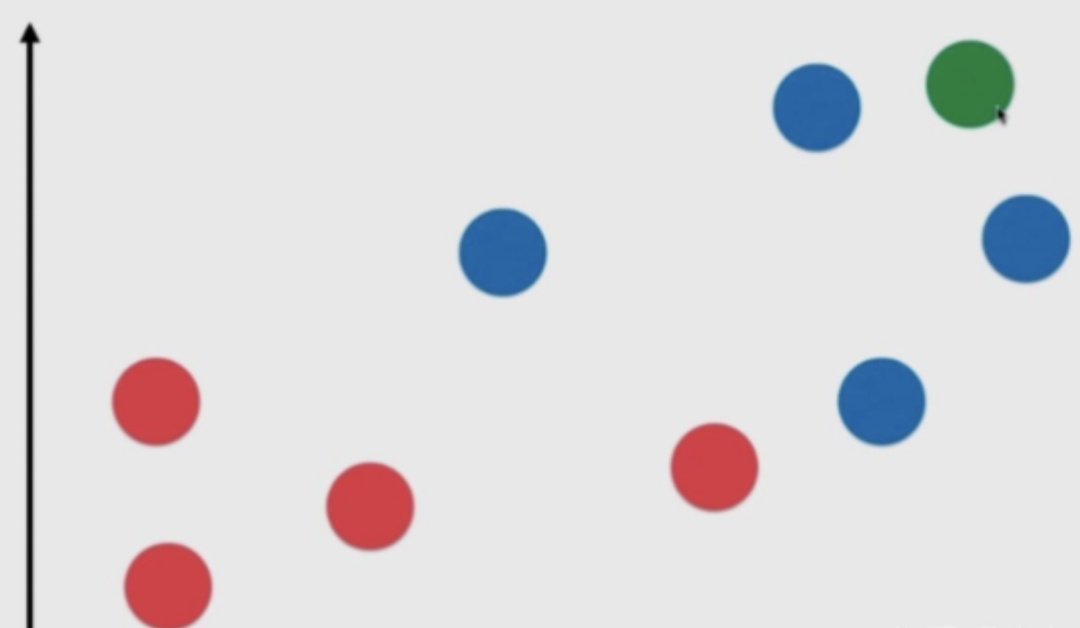
首先大致介绍一下KNN的思想,假设我们现在有两类数据集,一类是红色的点表示,另一类用蓝色的点表示,这两类点就作为我们的训练数据集,当有一个新的数据绿色的点,那么我们该怎么给这个绿色的点进行分类呢?
一般情况下,我们需要先指定一个k,当一个新的数据集来临时,我们首先计算这个新的数据跟训练集中的每一个数据的距离,一般使用欧氏距离。
然后从中选出距离最近的k个点,这个k一般选取为奇数,方便后面投票决策。在k个点中根据最多的确定新的数据属于哪一类。
KNN基础
1.先创建好数据集x_train, y_train,和一个新的数据x_new, 并使用matplot将其可视化出来。
import numpy as np
import matplotlib.pyplot as plt
raw_data_x = [[3.3935, 2.3313],
[3.1101, 1.7815],
[1.3438, 3.3684],
[3.5823, 4.6792],
[2.2804, 2.8670],
[7.4234, 4.6965],
[5.7451, 3.5340],
[9.1722, 2.5111],
[7.7928, 3.4241],
[7.9398, 0.7916]]
raw_data_y = [0, 0, 0, 0, 0, 1, 1, 1, 1, 1]
x_train = np.array(raw_data_x)
y_train = np.array(raw_data_y)
x_new = np.array([8.0936, 3.3657])
plt.scatter(x_train[y_train==0,0], x_train[y_train==0,1], color=’g’)
plt.scatter(x_train[y_train==1,0], x_train[y_train==1,1], color=’r’)
plt.scatter(x_new[0], x_new[1], color=’b’)
plt.show()
1.knn过程
2.计算距离
from math import sqrt
distance = []
for x in x_train:
d = sqrt(np.sum((x_new – x) ** 2))
distance.append(d)
# 其实上面这些代码用一行就可以搞定
# distances = [sqrt(np.sum((x_new – x) ** 2)) for x in x_train]
输出结果:
[10.888422144185997,
11.825242797930196,
15.18734646375067,
11.660703691887552,
12.89974598548359,
12.707715895864213,
9.398411207752083,
15.62480440229573,
12.345673749536719,
14.394770082568183]
将距离进行排序,返回的是排序之后的索引位置
nearsest = np.argsort(distances)
输出结果:array([6, 0, 3, 1, 8, 5, 4, 9, 2, 7], dtype=int64)
取k个点,假设k=5
k = 5
topk_y = [y_train[i] for i in nearest[:k]]
topk_y
输出结果:[1, 0, 0, 0, 1]
根据输出结果我们可以发现,新来的数据距离最近的5个点,有三个点属于第一类,有两个点属于第二类,根据少数服从多数原则,新来的数据就属于第一类!
投票
from collections import Counter
Counter(topk_y)
输出结果:Counter({1: 2, 0: 3})
votes = Counter(topk_y)
votes.most_common(1)
y_new = votes.most_common(1)[0][0]
输出结果:0
这样,我们就完成了一个基本的knn!
自己写一个knn函数
knn是一个不需要训练过程的机器学习算法。其数据集可以近似看成一个模型。
import numpy as np
from math import sqrt
from collections import Counter
def kNN_classifier(k, x_train, y_train, x_new):
assert 1 <= k <= x_train.shape[0], “k must be valid”
assert x_train.shape[0] == y_train.shape[0], “the size of x_train must be equal to the size of y_train”
assert x_train.shape[1] == x_new.shape[0], “the feature number of x_new must be equal to x_train”
distances = [sqrt(np.sum((x_new – x) ** 2)) for x in x_train]
nearest = np.argsort(distances)
topk_y = [y_train[i] for i in nearest[:k]]
votes = Counter(topk_y)
return votes.most_common(1)[0][0]
测试一下:
raw_data_x = [[3.3935, 2.3313],
[3.1101, 1.7815],
[1.3438, 3.3684],
[3.5823, 4.6792],
[2.2804, 2.8670],
[7.4234, 4.6965],
[5.7451, 3.5340],
[9.1722, 2.5111],
[7.7928, 3.4241],
[7.9398, 0.7916]]
raw_data_y = [0, 0, 0, 0, 0, 1, 1, 1, 1, 1]
x_train = np.array(raw_data_x)
y_train = np.array(raw_data_y)
x_new = np.array([8.0936, 3.3657])
y_new = kNN_classifier(5, x_train, y_train, x_new)
print(y_new)
使用sklearn中的KNN
from sklearn.neighbors import KNeighborsClassifier
import numpy as np
raw_data_x = [[3.3935, 2.3313],
[3.1101, 1.7815],
[1.3438, 3.3684],
[3.5823, 4.6792],
[2.2804, 2.8670],
[7.4234, 4.6965],
[5.7451, 3.5340],
[9.1722, 2.5111],
[7.7928, 3.4241],
[7.9398, 0.7916]]
raw_data_y = [0, 0, 0, 0, 0, 1, 1, 1, 1, 1]
x_train = np.array(raw_data_x)
y_train = np.array(raw_data_y)
x_new = np.array([8.0936, 3.3657])
knn_classifier = KNeighborsClassifier(n_neighbors=5)
knn_classifier.fit(x_train, y_train)
y_new = knn_classifier.predict(x_new.reshape(1, -1))
print(y_new[0])
自己写一个面向对象的KNN
import numpy as np
from math import sqrt
from collections import Counter
class KNNClassifier():
def __init__(self, k):
assert 1 <= k, “k must be valid”
self.k = k
self._x_train = None
self._y_train = None
def fit(self, x_train, y_train):
assert x_train.shape[0] == y_train.shape[0],
“the size of x_train must be equal to the size of y_train”
assert self.k <= x_train.shape[0],
“the size of x_train must be at least k”
self._x_train = x_train
self._y_train = y_train
return self
def predict(self, x_new):
x_new = x_new.reshape(1, -1)
assert self._x_train is not None and self._y_train is not None,
“must fit before predict”
assert x_new.shape[1] == self._x_train.shape[1],
“the feature number of x must be equal to x_train”
y_new = [self._predict(x) for x in x_new]
return np.array(y_new)
def _predict(self, x):
assert x.shape[0] == self._x_train.shape[1],
“the feature number of x must be equal to x_train”
distances = [sqrt(np.sum((x_train – x) ** 2)) for x_train in self._x_train]
nearest = np.argsort(distances)
topk_y = [self._y_train[i] for i in nearest[:self.k]]
votes = Counter(topk_y)
return votes.most_common(1)[0][0]
def __repr__(self):
return “KNN(k=%d)” % self.k
测试一下:
raw_data_x = [[3.3935, 2.3313],
[3.1101, 1.7815],
[1.3438, 3.3684],
[3.5823, 4.6792],
[2.2804, 2.8670],
[7.4234, 4.6965],
[5.7451, 3.5340],
[9.1722, 2.5111],
[7.7928, 3.4241],
[7.9398, 0.7916]]
raw_data_y = [0, 0, 0, 0, 0, 1, 1, 1, 1, 1]
x_train = np.array(raw_data_x)
y_train = np.array(raw_data_y)
x_new = np.array([8.0936, 3.3657])
knn_clf = KNNClassifier(6)
knn_clf.fit(x_train, y_train)
y_new = knn_clf.predict(x_new)
print(y_new[0])
分割数据集
import numpy as np
from sklearn import datasets
def train_test_split(x, y, test_ratio=0.2, seed=None):
assert x.shape[0] == y.shape[0], “the size of x must be equal to the size of y”
assert 0.0 <= test_ratio <= 1.0, “test_ratio must be valid”
if seed:
np.random.seed(seed)
shuffle_idx = np.random.permutation(len(x))
test_size = int(len(x) * test_ratio)
test_idx = shuffle_idx[:test_size]
train_idx = shuffle_idx[test_size:]
x_train = x[train_idx]
y_train = y[train_idx]
x_test = x[test_idx]
y_test = y[test_idx]
return x_train, y_train, x_test, y_test
sklearn中鸢尾花数据测试KNN
import numpy as np
from sklearn import datasets
from knn_clf import KNNClassifier
iris = datasets.load_iris()
x = iris.data
y = iris.target
x_train, y_train, x_test, y_test = train_test_split(x, y)
my_knn_clf = KNNClassifier(k=3)
my_knn_clf.fit(x_train, y_train)
y_predict = my_knn_clf.predict(x_test)
print(sum(y_predict == y_test))
print(sum(y_predict == y_test) / len(y_test))
# 也可以使用sklearn中自带的数据集拆分方法
from sklearn.model_selection import train_test_split
import numpy as np
from sklearn import datasets
from knn_clf import KNNClassifier
iris = datasets.load_iris()
x = iris.data
y = iris.target
x_train, y_train, x_test, y_test = train_test_split(x, y,
test_size=0.2, random_state=666)
my_knn_clf = KNNClassifier(k=3)
my_knn_clf.fit(x_train, y_train)
y_predict = my_knn_clf.predict(x_test)
print(sum(y_predict == y_test))
print(sum(y_predict == y_test) / len(y_test))
sklearn中手写数字数据集测试KNN
首先,先来了解一下手写数字数据集。
import numpy as np
import matplotlib.pyplot as plt
from sklearn import datasets
digits = datasets.load_digits()
digits.keys()
print(digits.DESCR)
y.shape
digits.target_names
y[:100]
x[:10]
some_digit = x[666]
y[666]
some_digit_image = some_digit.reshape(8, 8)
plt.imshow(some_digit_image, cmap=plt.cm.binary)
plt.show()
接下来,就开始动手试试。
from sklearn import datasets
from shuffle_dataset import train_test_split
from knn_clf import KNNClassifier
digits = datasets.load_digits()
x = digits.data
y = digits.target
x_train, y_train, x_test, y_test = train_test_split(x, y, test_ratio=0.2)
my_knn_clf = KNNClassifier(k=3)
my_knn_clf.fit(x_train, y_train)
y_predict = my_knn_clf.predict(x_test)
print(sum(y_predict == y_test) / len(y_test))
把求acc封装成一个函数,方便调用。
def accuracy_score(y_true, y_predict):
assert y_true.shape[0] == y_predict.shape[0],
“the size of y_true must be equal to the size of y_predict”
return sum(y_true == y_predict) / len(y_true)
接下来把它封装到KNNClassifier的类中。
import numpy as np
from math import sqrt
from collections import Counter
from metrics import accuracy_score
class KNNClassifier():
def __init__(self, k):
assert 1 <= k, “k must be valid”
self.k = k
self._x_train = None
self._y_train = None
def fit(self, x_train, y_train):
assert x_train.shape[0] == y_train.shape[0],
“the size of x_train must be equal to the size of y_train”
assert self.k <= x_train.shape[0],
“the size of x_train must be at least k”
self._x_train = x_train
self._y_train = y_train
return self
def predict(self, x_new):
# x_new = x_new.reshape(1, -1)
assert self._x_train is not None and self._y_train is not None,
“must fit before predict”
assert x_new.shape[1] == self._x_train.shape[1],
“the feature number of x must be equal to x_train”
y_new = [self._predict(x) for x in x_new]
return np.array(y_new)
def _predict(self, x):
assert x.shape[0] == self._x_train.shape[1],
“the feature number of x must be equal to x_train”
distances = [sqrt(np.sum((x_train – x) ** 2)) for x_train in self._x_train]
nearest = np.argsort(distances)
topk_y = [self._y_train[i] for i in nearest[:self.k]]
votes = Counter(topk_y)
return votes.most_common(1)[0][0]
def score(self, x_test, y_test):
y_predict = self.predict(x_test)
return accuracy_score(y_test, y_predict)
def __repr__(self):
return “KNN(k=%d)” % self.k
其实,在sklearn中这些都已经封装好了。
from sklearn.metrics import accuracy_score
from sklearn.model_selection import train_test_split
from sklearn.neighbors import KNeighborsClassifier
digits = datasets.load_digits()
x = digits.data
y = digits.target
x_train, x_test, y_train, y_test = train_test_split(x, y, test_size=0.2)
knn_classifier = KNeighborsClassifier(n_neighbors=3)
knn_classifier.fit(x_train, y_train)
knn_classifier.score(x_test, y_test)
超参数
k
在knn中的超参数k何时最优?
from sklearn.metrics import accuracy_score
from sklearn.model_selection import train_test_split
from sklearn.neighbors import KNeighborsClassifier
digits = datasets.load_digits()
x = digits.data
y = digits.target
x_train, x_test, y_train, y_test = train_test_split(x, y, test_size=0.2)
best_score = 0.0
best_k = -1
for k in range(1, 11):
knn_clf = KNeighborsClassifier(n_neighbors=k)
knn_clf.fit(x_train, y_train)
score = knn_clf.score(x_test, y_test)
if score > best_score:
best_k = k
best_score = score
print(“best k=”, best_k) print(“best score=”, best_score)
投票方式

上面这张图,绿色的球最近的三颗球分别是红色的1号,紫色的3号和蓝色的4号。如果只考虑绿色的k个近邻中多数服从少数,目前来说就是平票。
即使不是平票,红色也是距离绿色最近。此时我们就可以考虑给他们加个权重。一般使用距离的倒数作为权重。假设距离分别为1、 3、 4
红球:1 紫+蓝:1/3 + 1/4 = 7/12
这两者加起来都没有红色的权重大,因此最终将这颗绿球归为红色类别。这样能有效解决平票问题。 因此,这也算knn的一个超参数。
其实这个在sklearn封装的knn中已经考虑到了这个问题。在KNeighborsClassifier(n_neighbors=k,weights=?)
还有一个参数weights,一般有两种:uniform、distance。
from sklearn.metrics import accuracy_score
from sklearn.model_selection import train_test_split
from sklearn.neighbors import KNeighborsClassifier
digits = datasets.load_digits()
x = digits.data
y = digits.target
x_train, x_test, y_train, y_test = train_test_split(x, y, test_size=0.2)
best_method = “”
best_score = 0.0
best_k = -1
for method in[“uniform”, “distance”]:
for k in range(1, 11):
knn_clf = KNeighborsClassifier(n_neighbors=k, weights=method)
knn_clf.fit(x_train, y_train)
score = knn_clf.score(x_test, y_test)
if score > best_score:
best_method = method
best_k = k
best_score = score
print(“best_method=”, best_method)
print(“best k=”, best_k)
print(“best score=”, best_score)
p
如果使用距离,那么有很多种距离可以使用,欧氏距离、曼哈顿距离、明可夫斯基距离。
from sklearn.metrics import accuracy_score
from sklearn.model_selection import train_test_split
from sklearn.neighbors import KNeighborsClassifier
digits = datasets.load_digits()
x = digits.data
y = digits.target
x_train, x_test, y_train, y_test = train_test_split(x, y, test_size=0.2)
best_p = -1
best_score = 0.0
best_k = -1
for p in range(1, 6):
for k in range(1, 11):
knn_clf = KNeighborsClassifier(n_neighbors=k, weights=”distance”, p=p)
knn_clf.fit(x_train, y_train)
score = knn_clf.score(x_test, y_test)
if score > best_score:
best_p = p
best_k = k
best_score = score
print(“best_p=”, best_p)
print(“best k=”, best_k)
print(“best score=”, best_score)
编辑:黄飞